
Round fish · Shore and boat
Cod and codling
The north-east rock edges hold cod all year. In the west, wait for the first autumn blow and coloured water.
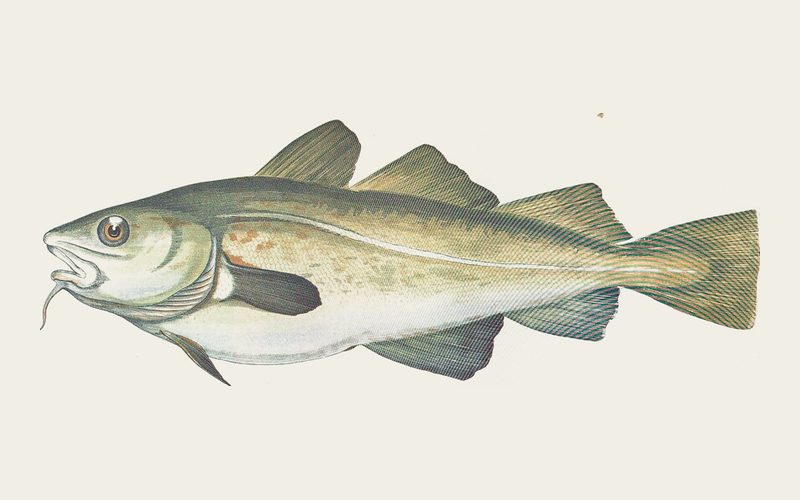
- Know it
- Pale lateral line that curves over the pectoral fin, single chin barbel, mottled olive-brown back.
- Bait
- Peeler crab, lugworm, mussel (east), squid and lug cocktails
- Table
- Excellent eating Gut soon and keep cold. Look for and remove small parasitic worms in the belly flesh; thorough cooking makes them harmless.
Season
Typical months on the North West and North East coasts, with this month ringed. Seasons shift a few weeks with water temperature and run differently around the coast: see each region's headline fish below.
Legal minimum size
Cod and codling
Last checked 18 October 2026Measured from the tip of the snout to the end of the tail (rays: wing tip to wing tip). Each region links to its regulator.
| Area | Minimum |
|---|---|
| North West England | 35cm |
| North Wales | 35cm |
| Yorkshire to the Tyne | 35cm |
| Northumberland | 35cm |
| Cardigan Bay and the Llyn | 35cm |
| Pembrokeshire, Gower and South Wales | None set |
| Dorset, Hampshire and the Solent | 35cm (check locally) |
| Kent, the Thames and Essex | 35cm (check locally) |
| Suffolk, Norfolk and the Wash | 35cm |
| Lincolnshire and the Humber | 35cm |
No size for this fish is listed in the regional rules we checked for Severn estuary, Somerset and North Devon, Cornwall and the Isles of Scilly, South Devon. That may mean none is set, or that the national rules apply: check locally.
and 5 other regionsRules change, usually each spring. Check the regulator for the area before you keep a fish.
A headline fish in
October to February
Pembrokeshire, Gower and South Wales
Vale of Glamorgan beaches and ledges at Llantwit Major and Barry. Lug and squid on a pulley rig on night tides.
October to February
Severn estuary, Somerset and North Devon
Portishead, Clevedon and Minehead on winter night tides. Lug and squid on a pulley rig. Cod are much scarcer up the channel than they were.
October to February
Dorset, Hampshire and the Solent
Chesil after a northerly with a little colour. Lug or squid, and stay on into dark.
November to January
Sussex
Langney Point and other deep-water beaches. Big lug or lug and squid baits.
November to February
Kent, the Thames and Essex
Dungeness and the deep Kent beaches after a blow. Big lug baits, or a banded lug sausage just past the shelf.
November to February
Suffolk, Norfolk and the Wash
Steep shingle at Cley, Sizewell and Cromer pier after a blow. Lug and squid cocktails on a pulley pennel, fished in the dark.
November to February
Lincolnshire and the Humber
The Humber walls from the first frosts. Paternoster pennel with two yellowtail lug, at dusk on a decent tide.
October to March
Scottish Borders to Aberdeen
Arbroath cliffs and Angus rock at night or in coloured water. Lug, crab or squid on a pulley or dongle rig with a rotten bottom.
October to March
Moray Firth, Caithness, Orkney and Shetland
Shetland voes and Orkney deep rock marks in winter. Fresh mackerel or squid on strong gear.
Where to catch it
Regions with marks where cod and codling is one of the main fish, and how many marks.
How to cook it
Gut soon and keep cold. Look for and remove small parasitic worms in the belly flesh; thorough cooking makes them harmless. Simple ways to cook it at home. More on bleeding, gutting, filleting and freezing in From sea to plate.

Method 1
Pan-fried fillet
Pat skinless fillets dry and season with salt and pepper. Fry in a little oil and butter over a medium-high heat for 3 to 4 minutes a side, depending on thickness, until the flesh turns white and flakes. Finish with lemon juice.
Method 2
Baked with a crumb
Lay thick fillets in an oiled dish, spread with a little butter and top with breadcrumbs mixed with chopped parsley and lemon zest. Bake at 200C (fan 180C) for 12 to 15 minutes until the crumb is golden and the fish flakes.